
What would life be like without photos? Precious moments would only be documented in stories, history would lose its visual evidence, and social media might never have become as popular as it is today.
Photography has evolved over nearly 200 years. Have you ever wondered what the world's first photograph looked like, and who the photographer was?
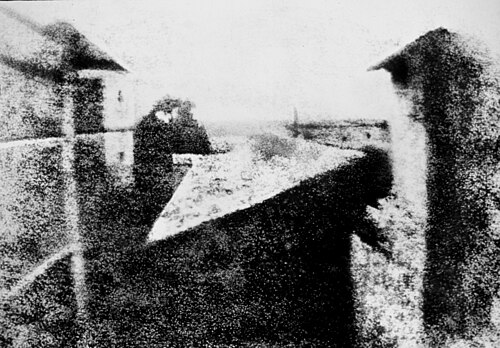
A landscape photograph taken from a second-story window overlooking the garden, created by Niépce around 1826 and 1827, is considered the world's first photograph.
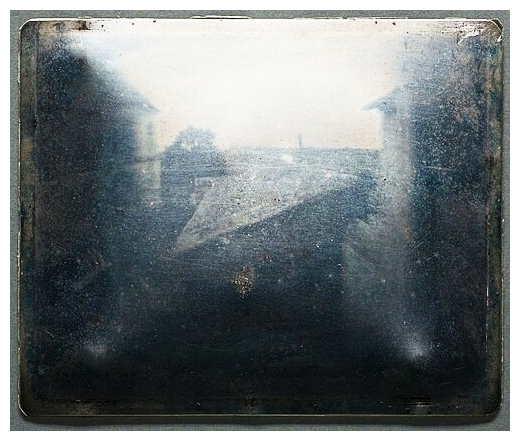
Joseph Nicéphore Niépce, a French aristocrat and inventor, succeeded in recording an image of light on a sheet of pewter plate coated with a light-sensitive chemical
The process was complex. Niépce placed the pewter plate, already coated with a light-sensitive chemical, inside a dark box with a small hole—the precursor to the modern camera obscura—to capture the view of the estate from his apartment window, in a small village located about six kilometers from the city of Chalon-sur-Saône.
Niépce's technique is called heliography—literally "writing with the sun." From this, the world's first image was born, although it required an exposure time of approximately eight hours to record on the plate. The work is named: Point de vue du Gras (View from the Window at Le Gras).
About a decade later, in 1839, Louis Daguerre refined Niépce's technique, creating a process that produced sharper images and reduced exposure time.
This photographic plate was once lost and rediscovered thanks to the persistence of renowned photography historian, Helmut Gernsheim, who found it in England in 1952. The photograph is permanently housed at the Musée Nicéphore Niépce in the center of Chalon-sur-Saône, France. Museum visitors can also see a replica of Niépce's workshop, where he took the photograph.
These discoveries were the beginning of the long evolution of the world of photography. Starting from Niépce's simple heliography technique, it then developed into complex technology: glass plate media, celluloid film, to digital sensors; from a chemical process it was transformed into electronics, and even AI has now entered the realm of photography. (***)